I’ll never forget the moment I realized a game was cheating for me. Struggling through a boss fight in Resident Evil 4 for the twentieth time, I finally scraped by with a sliver of health. But something felt off. The boss seemed slower. His attacks came with longer windups. The game had quietly decided I needed help.
That experience introduced me to AI difficulty adjustment, a technology that’s been quietly reshaping gaming for two decades. Whether you love it or hate it, understanding how these systems work changes how you experience games forever.
What Exactly Is AI Difficulty Adjustment?
Dynamic difficulty adjustment, often called DDA or rubber-banding, refers to systems that modify game challenge in real-time based on player performance. Unlike static difficulty settings you choose from a menu, these systems continuously evaluate how you’re playing and tweak variables behind the scenes.
The concept sounds straightforward, but implementation gets remarkably complex. Games must collect performance data, interpret that data meaningfully, and adjust parameters without players noticing the manipulation. Get any step wrong, and the illusion shatters.
Think of it like a good dungeon master in tabletop roleplaying. They’re constantly reading the room, dialing encounters up or down to maintain tension without crushing or boring their players. AI difficulty adjustment automates this intuition at computational scale.
How These Systems Actually Work
Most DDA implementations track several performance metrics simultaneously. Death frequency matters, obviously. But sophisticated systems also monitor damage taken per encounter, time spent on objectives, resource consumption rates, accuracy percentages, and even player movement patterns.
This data feeds algorithms that calculate your current skill level relative to the game’s expected baseline. Fall below that baseline, and the game eases up. Exceed it consistently, and challenges intensify.
The adjustments themselves vary wildly between games. Some modify enemy health pools or damage output. Others change spawn rates, alter timing windows for dodges and parries, or adjust how generous aim assist becomes. Racing games famously speed up opponents when you’re far ahead and slow them when you’re struggling—the classic rubber-band effect.
What matters most is subtlety. Players should feel challenged, not manipulated. The best implementations remain invisible. The worst feel patronizing or cheap.
Landmark Examples Worth Studying
Resident Evil 4 pioneered transparent DDA back in 2005. The game openly adjusted enemy aggression, damage values, and item drop rates based on recent performance. Die repeatedly to a section, and the game quietly became more forgiving. Breeze through encounters, and subsequent areas ramped up pressure.
Left 4 Dead’s “AI Director” took a different approach entirely. Rather than just adjusting numbers, it controlled the entire experience flow. The Director monitored player stress through engagement metrics, then orchestrated enemy spawns, supply placement, and ambient events to create cinematic pacing. Calm moments preceded intense crescendos. The system created emergent storytelling through difficulty management.
Mario Kart’s infamous rubber-banding represents a cruder but effective implementation. Fall behind, and you’ll receive better items while opponents slow slightly. This keeps races competitive regardless of skill gaps—great for family gaming sessions, frustrating for competitive players.
More recently, Hades demonstrated elegant DDA integration. Its “God Mode” option reduced incoming damage incrementally with each death, letting struggling players eventually overcome challenges while maintaining the core experience. The system respected player agency while providing invisible assistance.
The Ongoing Controversy
Not everyone appreciates AI difficulty adjustment. Some players feel cheated when games secretly help them, viewing victory as hollow if it wasn’t entirely earned. Others resent rubber-banding that punishes skilled play by artificially elevating competition.
The speedrunning community particularly dislikes DDA systems. When games adjust based on performance, runs become inconsistent. The same strategy might work differently across attempts because the game’s response varies.
There’s also a philosophical debate about challenge authenticity. If a boss becomes easier after repeated failures, did you really beat it? Or did the game simply decide you’d suffered enough? Different players answer that question differently.
Competitive multiplayer presents additional complications. DDA in ranked modes would undermine the entire point of skill-based competition. Most developers limit these systems to single-player or casual modes accordingly.
The Design Philosophy Behind Good DDA
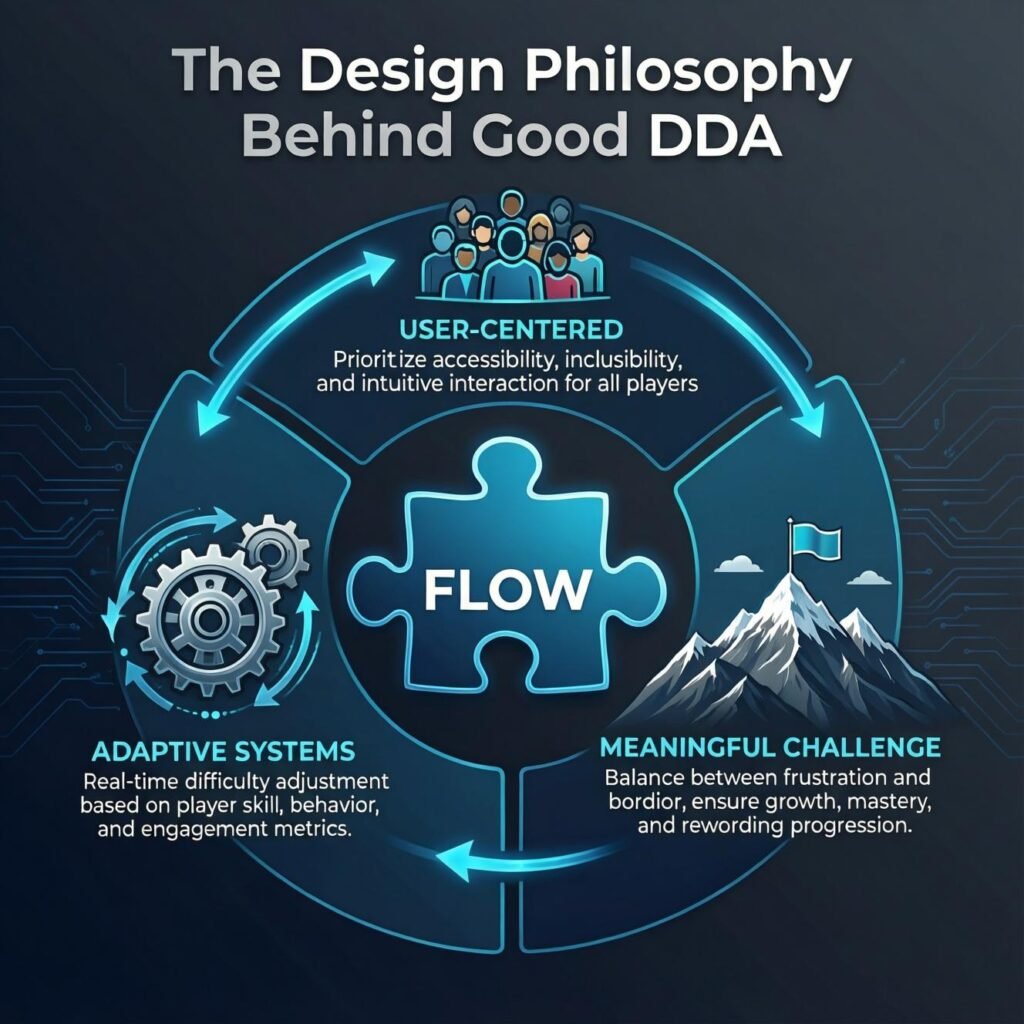
Having spoken with several developers about implementation philosophy, common wisdom emerges. The goal isn’t making games easier—it’s maintaining optimal challenge states.
Psychologist Mihaly Csikszentmihalyi described “flow” as the mental state between boredom and anxiety where peak engagement occurs. Good DDA aims to keep players in flow regardless of skill level. Too easy triggers boredom. Too hard triggers frustration. Both cause players to quit.
The key insight is that optimal difficulty differs between players and changes within individual play sessions. Someone might start sharp after coffee and slow down after hours of play. Static difficulty can’t accommodate these fluctuations. Dynamic systems can.
Transparency matters too. Some games explicitly show when DDA activates, respecting player intelligence. Others hide it completely, prioritizing immersion. Neither approach is universally correct—it depends on the game’s goals and audience expectations.
Where This Technology Heads Next
Modern DDA systems increasingly incorporate machine learning rather than simple rule-based algorithms. These systems identify nuanced patterns in player behavior, predicting frustration or boredom before they manifest obviously.
Biometric integration represents another frontier. Some developers experiment with heart rate monitors and facial expression tracking to gauge emotional states directly. Imagine games that sense when you’re genuinely stressed versus comfortably challenged.
Cloud processing enables more sophisticated player modeling than local hardware allows. Your play patterns across multiple games could inform difficulty calibration, creating personalized baselines rather than generic assumptions.
The ethical dimensions deserve attention here. When games become too good at maintaining engagement, the line between enjoyable challenge and addictive manipulation blurs. Responsible developers must consider whether their DDA systems serve player enjoyment or exploit psychological vulnerabilities.
Finding Your Own Balance
My advice? Know yourself. If you prefer mastering games through repeated failure, seek titles with transparent difficulty options you control. If you want smooth experiences that meet you where you are, embrace DDA systems designed for accessibility.
There’s no wrong way to enjoy games. AI difficulty adjustment simply offers another tool for matching experiences to players. Understanding how these systems work lets you make informed choices about the experiences you want.
Frequently Asked Questions
What is AI difficulty adjustment in games?
AI difficulty adjustment dynamically modifies game challenge in real-time based on player performance, making games harder or easier without requiring manual setting changes.
Which games use dynamic difficulty adjustment?
Notable examples include Resident Evil 4, Left 4 Dead, Hades, Mario Kart series, FIFA, and many modern single-player titles from major publishers.
Can I disable AI difficulty adjustment?
Some games offer options to lock difficulty settings or disable adaptive systems, though many implement DDA invisibly without opt-out features.
Is rubber-banding the same as difficulty adjustment?
Rubber-banding is one type of difficulty adjustment, specifically referring to systems that help losing players catch up, common in racing and sports games.
Does DDA affect multiplayer games?
Most competitive multiplayer modes disable DDA to maintain fair competition. It’s typically restricted to single-player or casual cooperative modes.
Is dynamic difficulty considered cheating?
Opinions vary. Some players feel assisted victories are hollow, while others appreciate accessibility features that let more people enjoy games regardless of skill level.